
B2B Fulfillment Services 2026: Complete Guide to Order Fulfillment, Distribution & Wholesale Logistics
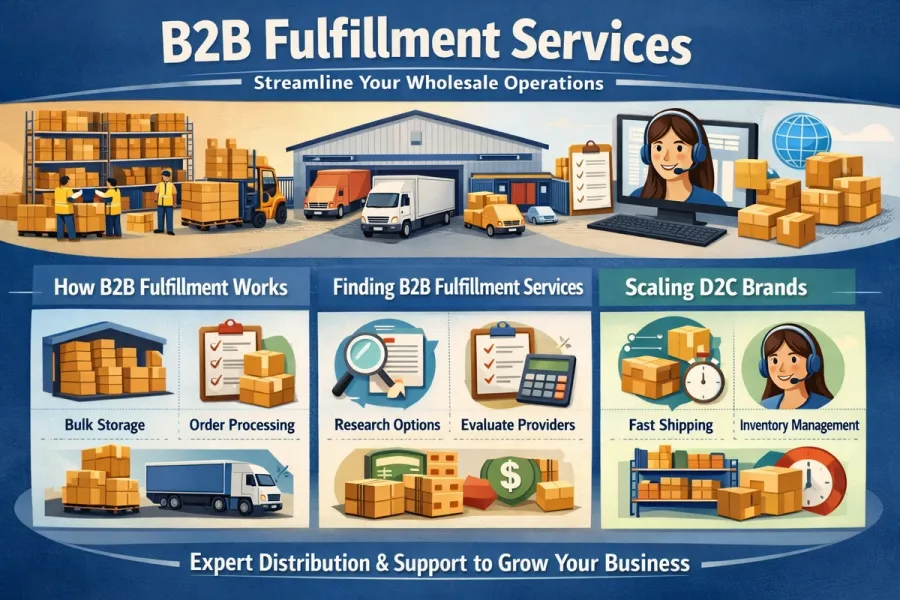
B2B fulfillment services streamline wholesale logistics for businesses handling bulk orders and complex distribution. This guide covers everything from finding top providers to understanding complete order fulfillment processes. SEO Title B2B Fulfillment Services 2026: Complete Order Fulfillment & Distribution Guide Meta Description Discover B2B fulfillment services, how order fulfillment works, and tips to find B2B distribution partners. Scale wholesale operations with expert logistics and customer support solutions. (148 characters) Short Description B2B fulfillment services manage warehousing, picking, packing, and shipping for wholesale orders. They handle palletized shipments, EDI integration, retail compliance, and nationwide distribution for manufacturers and distributors seeking scalable logistics without in-house infrastructure
April 6, 2026 · By PrepFort TeamB2B Fulfillment Services
B2B fulfillment services provide end-to-end logistics solutions specifically designed for business-to-business transactions, managing high-volume orders, palletized shipments, and complex compliance requirements that differ significantly from consumer retail models. These services typically include secure warehousing in strategic locations across major distribution hubs, advanced inventory management systems that track stock levels in real-time, automated picking and packing operations optimized for bulk quantities, and reliable shipping through freight carriers specializing in LTL and FTL deliveries. Companies leveraging B2B fulfillment services benefit from scalability during peak seasons, reduced operational overhead, and integration capabilities with enterprise software like ERP and EDI systems that ensure seamless data flow between sales teams and logistics partners.
Leading B2B fulfillment services in 2026 emphasize technology-driven efficiencies such as AI-powered demand forecasting to prevent stockouts, robotics for high-speed order processing, and customizable kitting services for promotional bundles or retailer-ready displays. For industries like manufacturing, apparel, and consumer packaged goods, these services handle specialized needs including hazardous materials compliance, temperature-controlled storage, and international export documentation. By outsourcing to expert B2B fulfillment providers, businesses achieve cost savings of 20-40% compared to in-house operations while maintaining service levels above 99% accuracy, which builds long-term trust with wholesale partners and distributors.
The value of B2B fulfillment services extends beyond basic logistics to include value-added services like custom labeling with GS1-128 barcodes required by major retailers, reverse logistics for efficient returns processing, and detailed reporting dashboards that provide insights into inventory turnover rates, carrier performance metrics, and fulfillment cost breakdowns. As e-commerce continues to blur lines between B2B and B2C, forward-thinking providers offer omnichannel capabilities that unify inventory across sales channels, ensuring availability for both pallet orders and parcel shipments without manual intervention.
B2B Order Fulfillment Services
B2B order fulfillment services focus on the precise execution of wholesale purchase orders from receipt through final delivery confirmation, incorporating steps like electronic data interchange for order ingestion, inventory allocation across multiple SKUs, wave picking for operational efficiency, and pallet building to exact customer specifications. These services excel in handling complex order profiles such as split-case picking for mixed pallets, third-party billing splits between vendors, and scheduled delivery appointments at retailer distribution centers to avoid dock penalties. Providers of B2B order fulfillment services prioritize accuracy and compliance, often guaranteeing 100% order perfection rates backed by performance-based refunds for any errors.
In practice, B2B order fulfillment services begin with automated validation of incoming EDI 850 purchase orders against contractual terms including pricing, quantities, and delivery windows, followed by dynamic slotting that positions high-velocity items closest to packing areas for reduced travel time. Once picked, orders receive protective packaging suitable for freight transit, compliance labeling for scan-based receiving, and advance shipment notices transmitted via EDI 856 to keep customers informed. Post-shipment tracking through customer portals provides proof of delivery documentation, invoice reconciliation support, and analytics to identify trends like seasonal demand spikes or carrier reliability issues.
For growing wholesalers, B2B order fulfillment services offer surge capacity during promotional campaigns or end-of-quarter pushes, activating additional warehouse space within 24-48 hours without disrupting regular operations. Integration with platforms like NetSuite, SAP, or Shopify Plus ensures real-time synchronization, eliminating data silos that cause delays in traditional setups. This streamlined approach not only accelerates cash flow through faster invoicing but also enhances customer satisfaction with predictable performance.
B2B Distribution and Fulfillment Service
B2B distribution and fulfillment services integrate transportation management with core warehousing to create optimized supply chains that minimize transit times and costs for nationwide or international distribution networks. These comprehensive solutions handle everything from inbound freight consolidation at cross-dock facilities to outbound routing via optimized carrier selection software that compares LTL rates across multiple providers in real-time. Strategic warehouse placement near major highways, ports, and population centers reduces landed costs while enabling same-day or next-day service to key markets.
Specialized B2B distribution and fulfillment services accommodate diverse requirements like multi-stop truckload planning to service regional retailers efficiently, zone skipping to bypass congested urban areas, and backhaul matching that fills return truck capacity with outbound loads. For manufacturers shipping to big-box chains, these services ensure compliance with strict routing guides from Walmart, Target, or Home Depot, preventing costly chargebacks through precise pallet configurations, strap patterns, and labeling protocols. Advanced transportation management systems provide end-to-end visibility, from load tendering to electronic POD upload, empowering clients with data-driven decisions.
As sustainability becomes a competitive differentiator, leading B2B distribution and fulfillment services incorporate carbon footprint calculators, electric vehicle routing for short hauls, and reusable packaging programs that reduce waste across the supply chain. This holistic approach transforms logistics from a cost center into a strategic advantage, enabling businesses to capture market share through superior delivery reliability and environmental responsibility.
Customer Support B2B Fulfillment
Customer support in B2B fulfillment elevates standard logistics into partnership-level service, featuring dedicated account managers who serve as single points of contact for issue resolution, performance reviews, and strategic planning. These support teams monitor key metrics like on-time in-full delivery rates, inventory accuracy, and order cycle times in real-time, proactively alerting clients to potential disruptions before they impact operations. 24/7 access to online portals allows self-service tracking, custom reporting, and order modifications, while live chat and phone support handle urgent requests like shipment rerouting or priority processing.
Exceptional customer support B2B fulfillment distinguishes top providers through rapid response SLAs—typically resolving discrepancies within four business hours—and compensation policies for service failures, such as credits for late deliveries or picking errors. Quarterly business reviews analyze trends, recommend process improvements, and align on upcoming initiatives like new product launches or market expansions. For complex scenarios involving multi-party coordination, support specialists facilitate communication between clients, carriers, and retailers to ensure seamless execution.
Beyond reactive support, proactive features like predictive alerts for low stock levels, carrier performance scorecards, and customized KPI dashboards empower clients to optimize their operations continuously. This relationship-focused approach fosters loyalty, with many long-term partnerships spanning decades as businesses scale from regional players to national leaders.
B2B Shipping and Wholesale Fulfillment Services
B2B shipping and wholesale fulfillment services specialize in high-volume replenishment orders for ongoing wholesale relationships, leveraging negotiated carrier contracts, volume-based discounts, and specialized equipment for palletized case goods shipments. These services excel at retail-ready preparation, including case picking for store shelf stocking, pallet licensing for reusable assets, and compliance with vendor compliance manuals that dictate everything from cube utilization to protective corner boards. Wholesale fulfillment providers optimize density through cubing software that maximizes trailer space, reducing per-unit shipping costs significantly.
For subscription-based wholesale models or vendor-managed inventory programs, B2B shipping and wholesale fulfillment services implement perpetual inventory systems that trigger automatic replenishments based on consumption data from retailer POS systems. Value-added assembly like kitting seasonal displays or bundling promotional items adds revenue streams while meeting just-in-time delivery schedules. Advanced routing algorithms consolidate orders across customers in the same geography, creating efficient milk-run delivery patterns that serve multiple stops per truckload.
Real-time integration with customer portals provides drop ship authorization tracking, order confirmation acknowledgments, and electronic invoicing that accelerates accounts receivable cycles. Analytics platforms reveal opportunities like regional carrier substitution for short-haul routes or packaging optimization for dimensional weight savings, driving continuous cost improvement.
Complete B2B Fulfillment Services
Complete B2B fulfillment services deliver fully integrated supply chain management under one provider, encompassing inbound receiving with quality inspections, long-term storage with cycle counting protocols, order processing with wave management, transportation execution, and aftermarket services like returns refurbishment. These turnkey solutions eliminate the coordination headaches of managing multiple vendors, providing unified technology platforms that offer true end-to-end visibility from factory floor to customer receiving dock.
Automation defines modern complete B2B fulfillment services, featuring goods-to-person picking robots, automated storage retrieval systems for dense inventory layouts, and conveyor networks that move pallets between processing zones without forklifts. AI-driven warehouse execution systems orchestrate labor across shifts, optimizing picker routes and consolidating freight for maximum efficiency. Quality control checkpoints at each stage—from receipt verification to final outbound inspection—maintain 99.9% accuracy rates essential for enterprise clients.
Scalability remains a hallmark, with network capacity expanding through satellite facilities or partner warehouses activated during demand surges. Financial integration handles multi-currency settlements, split billing across sales channels, and automated compliance reporting for international trade. This comprehensive coverage reduces total cost of ownership while enabling strategic focus on product innovation and market expansion.
How to Find B2B Fulfillment Services
Finding the right B2B fulfillment services requires systematic evaluation starting with a thorough audit of current logistics pain points, including order accuracy rates, cycle time benchmarks, and cost per order comparisons against industry standards. Define specific requirements based on product characteristics like size, weight, and regulatory needs, projected order volumes across seasons, and technology compatibility with existing systems like ERP or e-commerce platforms. Industry directories, trade publications, and platforms like Clutch.co provide initial shortlists filtered by vertical expertise and geographic coverage.
The RFP process uncovers true capabilities—request detailed proposals specifying SLAs for on-time delivery above 98%, inventory accuracy guarantees, and transparent pricing models without hidden accessorial fees. Critical evaluation criteria include warehouse tour validations revealing operational discipline, reference checks with similar-sized clients, and pilot program testing that simulates real workloads. Technology demonstrations should showcase WMS functionality, EDI mapping capabilities, and customer portal usability.
Contract negotiation secures favorable terms like volume-based pricing tiers, performance penalties with corresponding credits, and flexible scaling clauses for growth. Implementation planning includes data migration strategies, staff training protocols, and go-live contingency plans. Ongoing partnership success depends on quarterly reviews tracking KPIs against baselines and collaborative roadmap planning for emerging needs.
How B2B Fulfillment Helps D2C Brands
B2B fulfillment helps D2C brands diversify revenue by enabling wholesale channel expansion without compromising direct-to-consumer operations, through intelligent inventory pooling that allocates stock dynamically across order types while maintaining service levels. Hybrid fulfillment models process pallet quantities for distributors alongside parcel orders for end consumers from shared warehouses, leveraging economies of scale across both streams. Compliance expertise prepares products for enterprise customers with strict vendor standards, building credibility that unlocks major accounts.
Strategic allocation algorithms prevent wholesale bulk pulls from starving DTC fulfillment during peak periods, while unified reporting reveals channel performance insights guiding assortment decisions. D2C brands gain enterprise-grade capabilities like EDI ordering, pallet licensing, and routing compliance without building internal teams, accelerating path to wholesale profitability. Revenue mix optimization often sees wholesale comprising 40-60% of total sales within 18-24 months of activation.
Customer experience consistency across channels reinforces brand equity, with identical quality standards and tracking capabilities whether shipping single boxes or truckloads. Analytics platforms identify wholesale winners early, informing production planning and marketing investments. This dual-revenue approach provides cash flow stability and scale advantages critical for sustained growth.
How Order Fulfillment Works
Order fulfillment works through a structured sequence optimized for efficiency and accuracy, beginning with electronic order capture that validates availability, pricing, and delivery commitments against real-time inventory data. Warehouse management systems then orchestrate picking strategies—whether discrete order, batch, zone, or wave methods—selected based on order profile complexity and urgency requirements. Items travel to packing stations via optimized routes calculated by dynamic slotting algorithms that position fast-movers nearest high-activity areas.
Packing incorporates protective materials calibrated for product fragility and transit distance, compliance labeling for automated receiving, and shipping manifests generated through carrier rate-shopping engines. Outbound processing includes load consolidation for multi-stop efficiency, electronic tendering to preferred carriers, and advance shipment notifications that trigger customer receiving protocols. Post-shipment phases deliver proof of delivery capture, invoice transmission, and returns authorization workflows closing the order lifecycle.
Performance measurement across stages identifies bottlenecks, with cycle time tracking from order receipt to delivery confirmation informing continuous improvement. Technology layers like voice-directed picking, barcode scanning, and RFID for high-value goods ensure traceability throughout. This methodical approach scales reliably from hundreds to thousands of daily orders.
How B2B Fulfillment Works
B2B fulfillment works through enterprise-optimized processes adapting consumer fulfillment for wholesale scale and complexity, starting with EDI 850 purchase order ingestion that auto-populates warehouse systems with line-level details, contract terms, and delivery appointments. Multi-line orders trigger specialized picking waves consolidating requirements across customers, often floor-loading full pallets built to precise height, weight, and strap configurations dictated by receiver specifications.
Unique B2B elements include pallet licensing programs tracking reusable assets, third-party billing splits allocating costs across manufacturers and distributors, and carrier compliance ensuring routing guide adherence to avoid fines. Automation accelerates throughput with goods-to-person systems achieving 300+ lines per hour, while quality gates verify accuracy before outbound tendering. Advance shipment notices via EDI 856 provide receivers with carton-level contents for scan-based receiving, streamlining dock operations.
Post-delivery reconciliation matches invoices against receipts, processes RMA returns through restocking or liquidation paths, and feeds data into demand planning models. Continuous monitoring via executive dashboards tracks OTIF performance, cost per order trends, and service exception rates, driving proactive optimizations across the network.