
B2B and Retail Fulfillment Services: Build a Smarter Supply Chain
B2B and retail fulfillment services play a major role in helping brands move products efficiently from warehouse to retailer or end customer. As businesses grow, fulfillment becomes more complex becau
May 25, 2026 · By PrepFort TeamB2B and retail fulfillment services play a major role in helping brands move products efficiently from warehouse to retailer or end customer. As businesses grow, fulfillment becomes more complex because orders come from different channels, each with its own shipping rules, documentation requirements, and delivery expectations. A strong fulfillment strategy helps companies reduce delays, improve accuracy, and keep both retailers and customers satisfied.
For businesses selling through retail partners, wholesalers, marketplaces, and direct channels, fulfillment is no longer just about packing boxes and shipping orders. It is about managing compliance, maintaining inventory accuracy, coordinating freight, and meeting retailer expectations at every stage. That is why B2B and retail fulfillment services have become essential for modern commerce.
This article explains how B2B and retail fulfillment services work, why they matter, and how key sub-services like retailer EDI support, freight management, small parcel delivery, routing compliance, bulk consolidation, and inventory optimization help businesses scale with confidence.
What Are B2B and Retail Fulfillment Services?
B2B and retail fulfillment services refer to the systems and processes used to store, prepare, ship, and manage products for business customers and retail partners. Unlike standard direct-to-consumer fulfillment, these services often involve larger order volumes, stricter shipping rules, and more detailed coordination with stores, distributors, and supply chain partners.
In B2B fulfillment, orders are often shipped to warehouses, retail distribution centers, or commercial locations. In retail fulfillment, products may need to follow retailer-specific instructions, including labeling, palletization, carton standards, routing guides, and shipping windows. These requirements make fulfillment more complex, but also more valuable when handled correctly.
A successful fulfillment operation must balance speed, accuracy, compliance, and inventory control. If any of these areas fail, the result can be chargebacks, delays, rejected shipments, or unhappy buyers. That is why companies rely on specialized fulfillment services to manage both the operational and compliance side of the process.
Why B2B and Retail Fulfillment Matters
Modern supply chains are more demanding than ever. Retailers expect accurate data, reliable shipping, and proper documentation. B2B buyers expect consistent delivery and product availability. At the same time, brands need to control costs and keep inventory moving efficiently.
B2B and retail fulfillment services solve these challenges by creating structure. Instead of handling each shipment manually, businesses can rely on streamlined workflows that support order accuracy, faster processing, and better visibility. This is especially important when selling across multiple channels, because each channel may have different fulfillment requirements.
Another reason this matters is customer experience. Retail buyers and business partners are less forgiving than individual consumers when shipments are late or incorrect. A well-managed fulfillment system helps protect relationships, reduce errors, and support long-term growth.
Retailer EDI Support
Retailer EDI support is one of the most important parts of B2B and retail fulfillment services. EDI, or Electronic Data Interchange, allows businesses and retailers to exchange order data, invoices, shipping notices, and other documents electronically. This reduces manual work and helps create a more accurate, efficient process.
Retailers often require EDI for purchase orders, advanced shipping notices, and invoicing. Without proper EDI support, a business may struggle to stay compliant with retailer requirements. That can lead to shipment delays, rejected orders, and administrative problems.
A strong retailer EDI support system helps businesses receive orders quickly, respond with the correct shipping documents, and keep all parties informed. It also improves visibility into order status and makes it easier to manage larger account relationships. For companies working with big-box stores or wholesale partners, this is not optional — it is a core operational need.
Why EDI Support Improves Accuracy
EDI reduces the chance of human error because data moves directly between systems. Instead of manually entering order details, shipping information can be transferred automatically. That improves speed, consistency, and reporting accuracy.
Freight Management
Freight management is another key part of B2B and retail fulfillment services. Many B2B orders are too large for standard parcel shipping, which means freight becomes the better option. Freight management involves planning, booking, tracking, and optimizing shipments that move on pallets or in larger commercial loads.
Good freight management helps businesses choose the right shipping method, reduce costs, and ensure goods arrive on time. It also helps with coordination between warehouses, carriers, and receiving locations. Since freight shipments often have more complex handling rules than small parcel delivery, strong planning is essential.
Freight management also matters because it affects fulfillment cost and transit performance. A poorly managed freight operation can lead to damaged products, delayed deliveries, or unexpected surcharges. A well-managed one supports smoother distribution and better customer satisfaction.
Freight and Supply Chain Control
When freight is managed properly, businesses gain more control over their supply chain. They can plan shipments more effectively, reduce waste, and align transportation with inventory needs. This makes freight management a strategic function, not just a shipping task.
Small Parcel Delivery
Small parcel delivery is an important service for businesses that ship smaller B2B or retail orders. These shipments are typically sent through parcel carriers and are common for replenishment orders, direct-to-store shipments, sample orders, and smaller retail deliveries.
In B2B and retail fulfillment services, small parcel delivery offers flexibility and speed. It is often used when freight is unnecessary or when businesses need to move products quickly in smaller quantities. Because parcel delivery is easier to track and faster to process, it plays a valuable role in mixed fulfillment operations.
The challenge with small parcel delivery is maintaining efficiency while controlling costs. Businesses need proper packaging, carrier selection, tracking visibility, and delivery planning. If not managed carefully, parcel shipments can become expensive and inconsistent.
Why Parcel Delivery Still Matters
Even in a freight-heavy environment, small parcel delivery remains essential. Many retail and B2B operations depend on it for fast-moving or lower-volume orders. When integrated into a broader fulfillment strategy, it helps businesses stay agile.
Routing Compliance
Routing compliance is one of the most overlooked parts of B2B and retail fulfillment services, but it is one of the most important. Retailers often have strict routing guides that explain how products must be shipped, labeled, packed, and delivered. If a supplier ignores these rules, the retailer may issue penalties or reject the shipment.
Routing compliance ensures that each order follows the correct shipping instructions. This can include carrier selection, appointment scheduling, pallet configuration, carton labeling, shipping document formatting, and delivery timing. Meeting these requirements is essential for maintaining retailer relationships.
A strong routing compliance process helps businesses avoid chargebacks and shipping issues. It also reduces confusion inside the warehouse because the team knows exactly how each order should be prepared.
How Routing Compliance Protects Revenue
Chargebacks and rejected shipments can hurt margins quickly. By following routing compliance rules, businesses reduce the risk of avoidable financial losses and protect their retail partnerships.
Bulk Consolidation
Bulk consolidation is another powerful part of B2B and retail fulfillment services. Instead of shipping many smaller loads separately, businesses combine multiple products or orders into fewer larger shipments. This can reduce transportation costs, simplify handling, and improve warehouse efficiency.
Bulk consolidation is especially useful when shipping to distribution centers, retail locations, or business customers that accept larger deliveries. It allows companies to maximize truck space and minimize unnecessary shipping fragmentation.
This service also helps businesses manage inventory movement more strategically. By consolidating bulk orders, companies can reduce shipping frequency while still meeting demand. That can improve operational efficiency and lower transportation pressure.
Why Consolidation Helps Operations
Bulk consolidation creates a more organized shipping process. It reduces redundant shipments, simplifies freight planning, and often improves cost control. For businesses shipping at scale, that makes a real difference.
Inventory Optimization
Inventory optimization is one of the most important services in B2B and retail fulfillment because it affects every part of the operation. If inventory levels are too low, orders may be delayed. If inventory levels are too high, storage costs increase and capital gets tied up in slow-moving stock.
Inventory optimization helps businesses determine the right amount of stock to keep, where to keep it, and how to move it efficiently. It uses demand data, sales patterns, reorder points, and warehouse visibility to make better stocking decisions.
In B2B and retail fulfillment services, inventory optimization improves order fill rates and supports better planning. It helps businesses avoid stockouts, reduce excess inventory, and respond more effectively to demand changes.
Inventory Visibility Matters
The more visibility a company has into its inventory, the easier it is to fulfill orders accurately and on time. That is why inventory optimization should be supported by strong systems and regular review.
How These Services Work Together
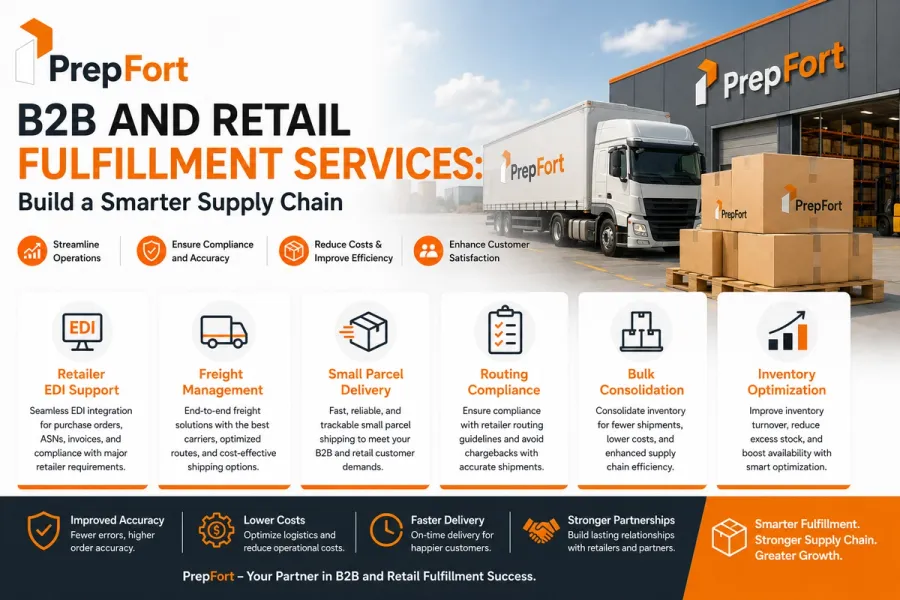
The real strength of B2B and retail fulfillment services comes from how all these sub-services connect. Retailer EDI support ensures orders flow smoothly from retailer systems into the warehouse. Freight management handles larger shipments efficiently. Small parcel delivery supports smaller or faster orders. Routing compliance keeps shipments aligned with retailer rules. Bulk consolidation improves shipping efficiency. Inventory optimization keeps stock levels healthy and responsive.
When these services work together, fulfillment becomes more reliable and scalable. Businesses spend less time correcting errors and more time growing sales. Retailers receive shipments that meet their requirements. Business customers get products on time. The warehouse operates with more structure and fewer surprises.
This integrated approach is especially valuable for growing brands that sell across multiple channels. Instead of building separate processes for every order type, they can use one fulfillment strategy that supports both B2B and retail needs.
Choosing the Right Fulfillment Partner
Selecting the right provider for B2B and retail fulfillment services requires careful evaluation. Businesses should look for a partner that understands retail requirements, has experience with EDI workflows, and can manage freight and parcel shipping efficiently. They should also make sure the provider can support routing compliance and inventory visibility.
A strong fulfillment partner should be able to adapt to different business models and order types. Some companies need more freight support, while others depend heavily on small parcel delivery. Some work with major retailers, while others focus on wholesale distribution. The right partner should be flexible enough to handle these needs without creating extra complexity.
It is also important to choose a partner that communicates clearly and provides reliable reporting. Fulfillment is not just about shipping products. It is about maintaining control and building confidence across the supply chain.
Common Challenges in B2B and Retail Fulfillment
Even with strong systems, businesses still face challenges in B2B and retail fulfillment. Retailer requirements may change. Inventory demand may shift suddenly. Freight costs may fluctuate. Small parcel orders may increase during peak periods. Each of these issues can create pressure on the supply chain.
The best way to handle these challenges is through planning and visibility. Businesses that track data closely and maintain structured workflows are better prepared to respond. They can adjust inventory, rework shipping strategies, and maintain compliance even when conditions change.
Another common challenge is communication between teams. When sales, warehouse, and shipping teams are not aligned, errors increase. A strong fulfillment strategy brings these teams together through shared processes and reporting.
Final Thoughts
B2B and retail fulfillment services are essential for businesses that want to grow without losing control of their supply chain. Retailer EDI support, freight management, small parcel delivery, routing compliance, bulk consolidation, and inventory optimization all play important roles in making fulfillment more efficient and reliable.
The best fulfillment systems are not built around one service alone. They are built around coordination. When every part of the process works together, businesses can ship faster, reduce errors, and keep retailers and buyers satisfied.
As your business grows, fulfillment becomes more than an operational task. It becomes a competitive advantage. A strong B2B and retail fulfillment strategy helps protect margins, improve service, and support long-term success.